
The 232nd Session of the Shanghai Science Communication Forum Successfully Held, Exploring the Future of the Universe with a Nobel Laureate
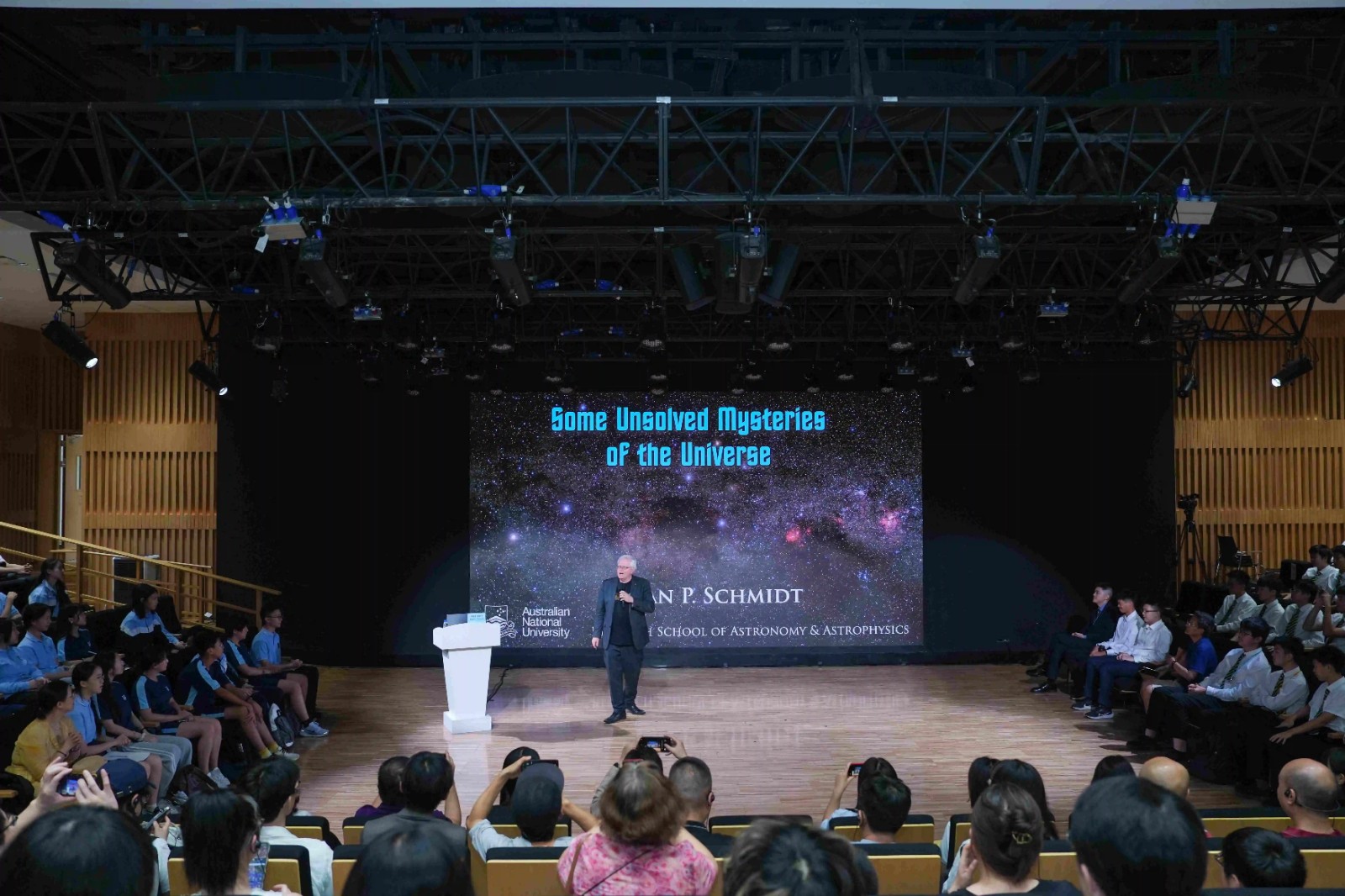
On October 15, 2025, the 232nd session of the Shanghai Science Communication Forum, titled “New Perspective, New Universe,” was held at the East Wing of the Shanghai Library. The event was co-hosted by the Shanghai Science and Technology Museum (SSTM), Shanghai Library, the Shanghai Science Education Development Foundation, and the Australian National University. The organizers specially invited Nobel laureate Professor Brian P. Schmidt from the Australian National University to deliver a science lecture. Professor Schmidt was awarded the 2011 Nobel Prize in Physics together with Saul Perlmutter and Adam Riess for discovering the accelerating expansion of the universe through observations of distant supernovae. The event also specially invited Professor Zu Ying from Shanghai Jiao Tong University and astronomy enthusiasts from the International Division of Shanghai High School to participate in a roundtable discussion.
Professor Brian P. Schmidt delivered a profound and captivating journey into cosmic exploration with his lecture titled “Some Unsolved Mysteries of the Universe.” He began with Einstein’s proposed and later abandoned “cosmological constant,” then moved to Hubble’s discovery of the expanding universe, and then presented the groundbreaking finding made in 1998 by the team he led which was based on observations of Type Ia Supernovae. The finding demonstrated that the expansion of the universe is accelerating. He described for the public the magnificent past and the astonishing future of the universe. Professor Schmidt’s discovery also revealed that the universe is a marvelous mixture composed of approximately 70% dark energy, about 25% dark matter, and roughly 5% ordinary atomic matter.
Students from the Physics Club of the International Division of Shanghai High School engaged in discussions with Professor Brian P. Schmidt and Professor Zu Ying on topics such as “How will artificial intelligence change astrophysics?” and “The impact of dark energy on the ultimate fate of the universe.” They also invited the two professors to share how to help the public appreciate the beauty of astronomy, as well as their advice for students aspiring to pursue scientific research. Following the roundtable discussion, the two experts also held an enthusiastic question-and-answer interaction with both online and onsite audiences.
More than 200 audiences, including representatives of Shanghai secondary school students and astronomy enthusiasts, attended the onsite lecture. The combined livestream viewership across more than ten online platforms reached 3.38 million. Audience members stated that having the opportunity to listen to a master-level lecture by a Nobel laureate and to engage in face-to-face exchanges with a professor from Shanghai Jiao Tong University, sparking intellectual exchange and reflection on the ultimate fate of the universe, was extremely rare and valuable.
Since its inaugural session in 2009, the Shanghai Science Communication Forum has invited a total of 473 leading scientists, including Nobel Prize laureates and academicians from China and abroad, and has held 286 outstanding science lectures. To date, more than 39.6 million online and onsite audience members have attended the lectures.

 LINK :


