
Decoding Speed and Safety on the F1 Track: 245th Shanghai Science Communication Forum Held
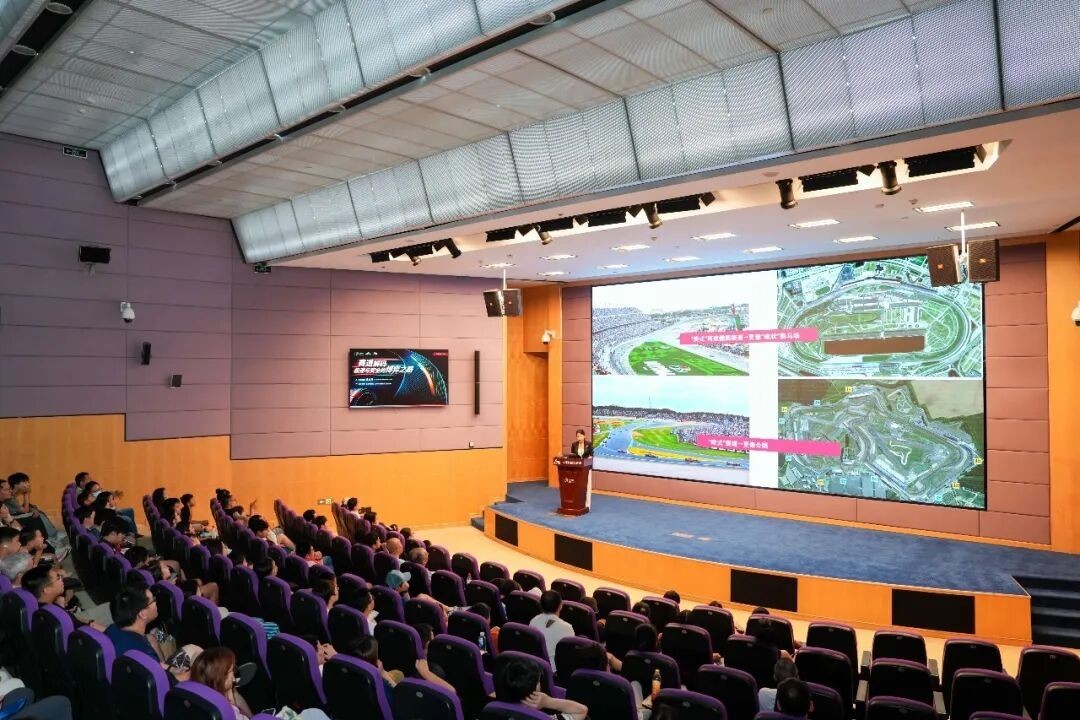
On August 15, the 245th Shanghai Science Communication Forum was successfully held. The event featured a special science lecture titled "Decoding the Racetrack: The Balance Between Speed and Safety," delivered by the Deputy Chief Engineer of Tongji University Design Group. The lecture introduced the public to the physical principles of motorsport, racetrack engineering technologies, and innovations in traffic safety.
Tracing the century-long history of motorsport, the lecture reviewed the evolution of motorsport technologies and safety systems. By examining key milestones, including the first automobile race in 1894 and the major safety incident during the 1903 Paris to Madrid race, the lecture explained the historical inevitability of motorsport's gradual transition from racing on public roads to competitions on closed circuits. It also highlighted a fundamental principle of the industry: advances in speed must be underpinned by scientifically designed safety systems.
The speaker simplified the complex mechanisms of racing cars into classical physics models, closely integrating fundamental physical principles with racing engineering practices through scenarios involving driving at the limits on straightaways and through corners. Beginning with the challenges of cornering at the limits of vehicle performance and drawing on the notable case of tire failures in Formula 1 in 2005, the lecture explored advances in tire technology, the speed advantages of bowl shaped racetracks, vehicle steering characteristics, and the demanding effects of high G forces on drivers. It provided a comprehensive analysis of the technical challenges and safety principles underlying racing at extreme speeds.
At the same time, the speaker also revealed the systematic safety design of world-class racetracks from the professional perspective of a circuit designer. Modern circuits employ technologies such as computer simulations of ideal racing lines under extreme vehicle operating conditions to establish robust safety safeguards for motorsport events. The lecture also presented innovations in intelligent and environmentally sustainable racetrack development, explaining how advanced technologies from motorsport are increasingly being applied to civilian transportation, delivering widespread benefits by enhancing safety on urban roads.
With its technically rigorous yet accessible scientific content, vivid examples from motorsport events, and firsthand insights from a racetrack design expert, the science lecture attracted numerous members of the public. The interactive session featured lively discussions, with audience members actively raising questions and engaging in in-depth exchanges on topics of interest, including technological applications and transportation development.

 LINK :


