
"Meet @ Scientists" Focuses on Life Sciences and Pays Tribute to Female Scientist Rosalind Franklin
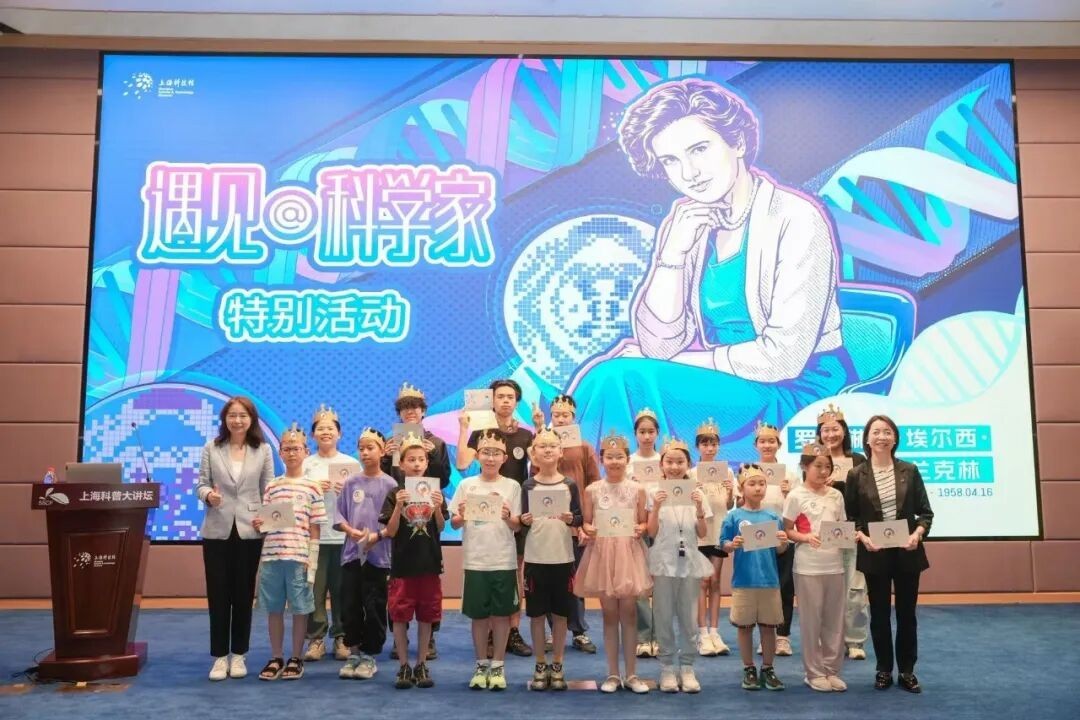
To pay tribute to pioneering scientists and promote the spirit of scientists, a special event titled "Meet @ Scientists: A Tribute to Rosalind Elsie Franklin" was successfully held in the lecture hall of the SSTM on the afternoon of July 25.
The event specially invited a professor from Fudan University to present birthday cards and customized "Meet @ Scientists" birthday souvenirs to 30 participants who shared the same birthday as Rosalind Elsie Franklin.
During the science lecture, the professor delivered a presentation titled "Dark Matter in Genetic Information: RNA, the Twin Sister of DNA," taking the audience on a journey through life sciences, from the DNA double helix to lariat RNA.
The professor reviewed the development of molecular biology and introduced the audience to the scientific research story of Rosalind Franklin. It was the crucial evidence provided by Franklin's "Photo 51" that enabled scientists to successfully decipher the double helix structure of DNA, laying a solid foundation for modern genetic research. Building on this, the professor explained the central dogma of molecular biology in accessible terms and outlined the classical framework of genetic research, helping the audience understand the central role of DNA as the carrier of genetic information. According to the central dogma, genetic information flows from DNA to RNA and then to proteins. However, 98% of the sequences in the human genome do not code for proteins. The vast quantities of noncoding RNA transcribed from these sequences are as elusive as dark matter in the universe, yet they control whether genes are switched on or off.
RNA has long been referred to as the twin sister of DNA, while noncoding RNA has been regarded as the "dark matter of life" within genetic information and was once dismissed by the scientific community as useless molecular waste. Drawing on a decade of research conducted by her team, the professor provided a detailed explanation focusing on representative types of noncoding RNA. She introduced a major research achievement published in the journal Science by her team in collaboration with a research team led by a researcher from the Chinese Academy of Sciences. From the classical deciphering of DNA structure to cutting-edge breakthroughs in RNA regulation, generations of researchers have continued to pursue scientific inquiry and venture into the unknown, passing down the innovative spirit of striving for new heights and daring to be pioneers. At the conclusion of the lecture, the audience responded with enthusiastic applause. Participants eagerly raised their hands to ask questions and engaged in lively discussions with Professor Zheng Binglian.
Following the lecture, the 30 birthday celebrants participated in the "Science Communication Experience Fair," an activity carefully planned by SSTM for the event. The original science course "Water Droplet Microscope" combined optics and biology. Under the guidance of science instructors, participants built simple projection and observation systems themselves. Using natural water droplets as light-transmitting lenses and laser illumination to magnify the forms of microorganisms in water, they clearly projected images of microscopic life onto the inner walls of a dark box, immersing themselves in an exploration of the fascinating mysteries of the microscopic world.
Each month, the "Meet @ Scientists" program selects an outstanding scientist in the history of science who was born in that month and organizes a "Scientist Theme Month" event. In 2026, the program underwent a comprehensive upgrade, introducing a variety of activities, including scientist birthday celebrations, scientist storytelling sessions, and the Science Communication Experience Fair (science performances, science lectures, STEM courses, VR/MR experiences, mini exhibitions, and online promotion). Through multiple channels and a multidimensional approach, the program showcases scientists' research achievements, promotes the spirit of scientists, builds scientists into "stars," and fosters a new social culture of respect for science, providing lasting momentum for improving scientific literacy among the general public.

 LINK :


