
Let Everything Around Us Become a Starting Point for Scientific Inquiry! Rural Teachers'' Science Education Empowerment Training Camp Held
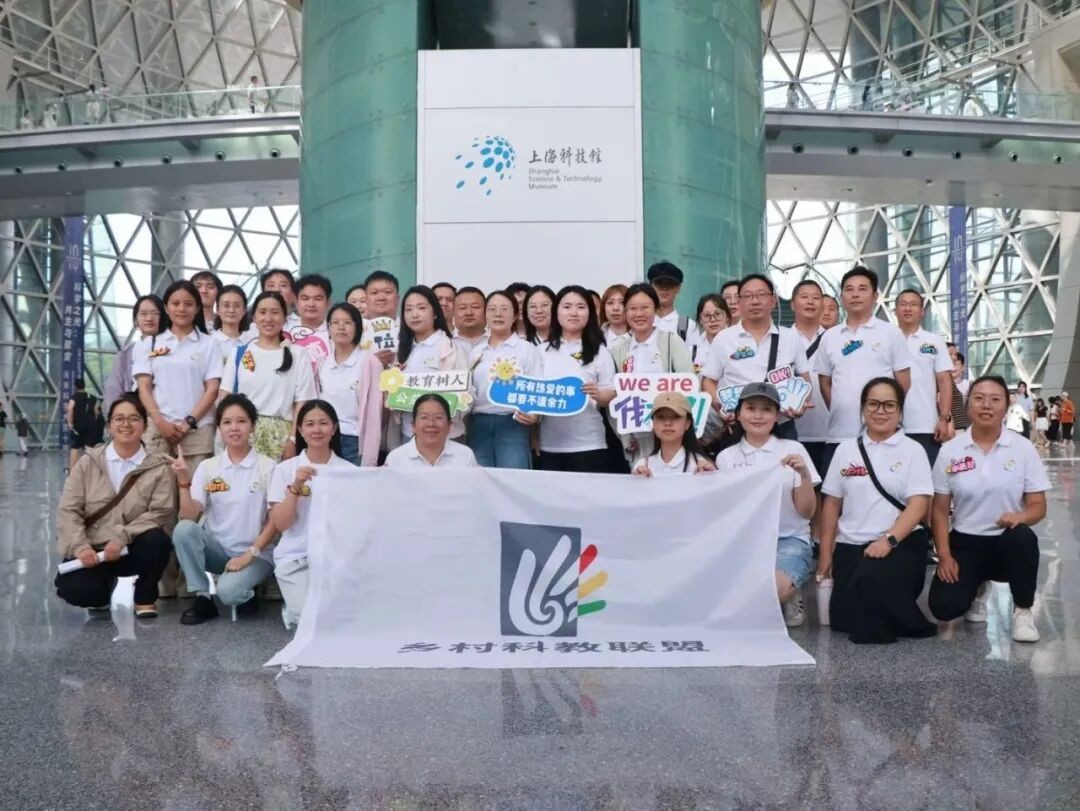
From July 28 to August 2, the Rural Teachers' Science Education Empowerment Training Camp was successfully held. Jointly organized by the SSTM and the Shanghai Dreams Come True Public Welfare Foundation, the event was themed "Science Is Everywhere Around Us: Teaching Practice from Scientific Thinking to AI Empowerment." A total of 36 key rural teachers from 29 schools across six provinces and municipalities, namely Yunnan, Hunan, Guizhou, Gansu, Qinghai, and Shanghai, participated in the training program.
At the opening ceremony, Xue Wei, Deputy Director of SSTM, and He Peixin, Chairman of the Shanghai Dreams Come True Public Welfare Foundation, delivered speeches respectively, marking the beginning of the training camp. Subsequently, guided by volunteer mentors, the participating teachers engaged in learning activities, hands-on experiences, and discussions centered on practical challenges encountered in classroom teaching. Through these activities, they deepened their understanding of science education and explored specific ways to translate what they had learned during the training into classroom practice.
The opening ceremony on the first day of the training camp was held at SSTM. Ni Minjing, Director of SSTM, delivered the opening lecture, titled "Experimentation Is What Science Should Be All About," to the participants.
The lecture went beyond experimental techniques to address the essence of science education: enabling students to encounter real phenomena and engage in observation, questioning, experimentation, and verification, thereby developing scientific thinking through hands-on practice. The lecture also addressed the practical realities of rural classrooms. Scientific inquiry does not necessarily depend on expensive equipment, as the surrounding environment itself offers abundant teaching resources. What teachers need to do is identify potential questions in everyday life and create opportunities for students to engage in hands-on activities, learn through trial and error, and express their ideas. When knowledge moves beyond textbooks and into practice, science classes are no longer simply about presenting conclusions but become a way of understanding the world.
That afternoon, the teachers visited the permanent exhibition areas of SSTM. Interactive installations, scientific models, and contextualized displays transformed abstract scientific principles into experiences that could be observed, explored through hands-on interaction, and verified. During the visit, the teachers went beyond simply viewing the exhibits and continually reflected on them from a teaching perspective: how a phenomenon could be used to raise questions, how an interactive activity could connect hypotheses with verification, and how scientific content presented in the museum could be brought back into rural classrooms. By combining observation, hands-on experiences, and lesson preparation, the teachers turned the permanent exhibition areas into a "large classroom" that opened up new ways of scientific thinking.
The teachers then visited the special exhibition "Light of Science: Symbiosis and Fusion, Future Science Prize 10th Anniversary Special Exhibition," shifting their focus from scientific principles to the process of scientific discovery. Research archives displayed publicly for the first time, calculation manuscripts bearing repeated revisions, experimental instruments used over many years, and reconstructed research settings enabled the teachers to see the trial and error, patience, and perseverance behind scientific achievements. Guided by volunteer mentors, they further considered how to transform these authentic scientific research stories into questions that rural students could understand, feel motivated to ask, and continue to explore. While the permanent exhibition areas made science tangible and accessible, the special exhibition demonstrated how scientific discoveries unfold step by step. The two visits complemented each other, together forming an on-site lesson preparation experience that connected museum-based learning with classroom lesson design.
SSTM hosted the activities on the first day of the training camp. Over the following five days, the training continued to focus on the practical needs of science teaching in rural classrooms. Building on scientific literacy and experimental teaching, the courses progressively incorporated AI-assisted teaching and project-based learning into lesson design. Through hands-on activities, group discussions, and lesson plan refinement, the program helped teachers translate what they had learned during the training into classroom plans suited to the specific circumstances of their schools. Throughout the program, the teachers focused on practical issues, including how to conduct experiments with limited resources and how to increase students' participation in scientific inquiry. Workshops guided them in developing teaching resources from local environments and commonly available materials, while improving their lesson plans through discussion and revision. AI tools were also applied to specific teaching tasks, helping teachers broaden their approaches to lesson preparation, design learning activities, and enhance their ability to address practical teaching challenges.
Following the six days of intensive training, the project will enter a phase of ongoing follow-up and application of training outcomes. Over the course of one academic year, the organizers will conduct follow-up classroom visits, collect case studies, and provide professional support to help participating teachers translate their training outcomes into school-based lesson plans and classroom practice. By combining professional training, museum-based educational visits, and teaching practice, the training camp has provided a platform for rural science teachers to exchange ideas and develop professionally. It has also generated practical experience in enabling high-quality science education resources to serve rural schools more effectively.

 LINK :


