
Explore the World of Embodied Intelligence and Meet Humanoid Robots Face to Face at the Future Science and Technology Innovation Camp
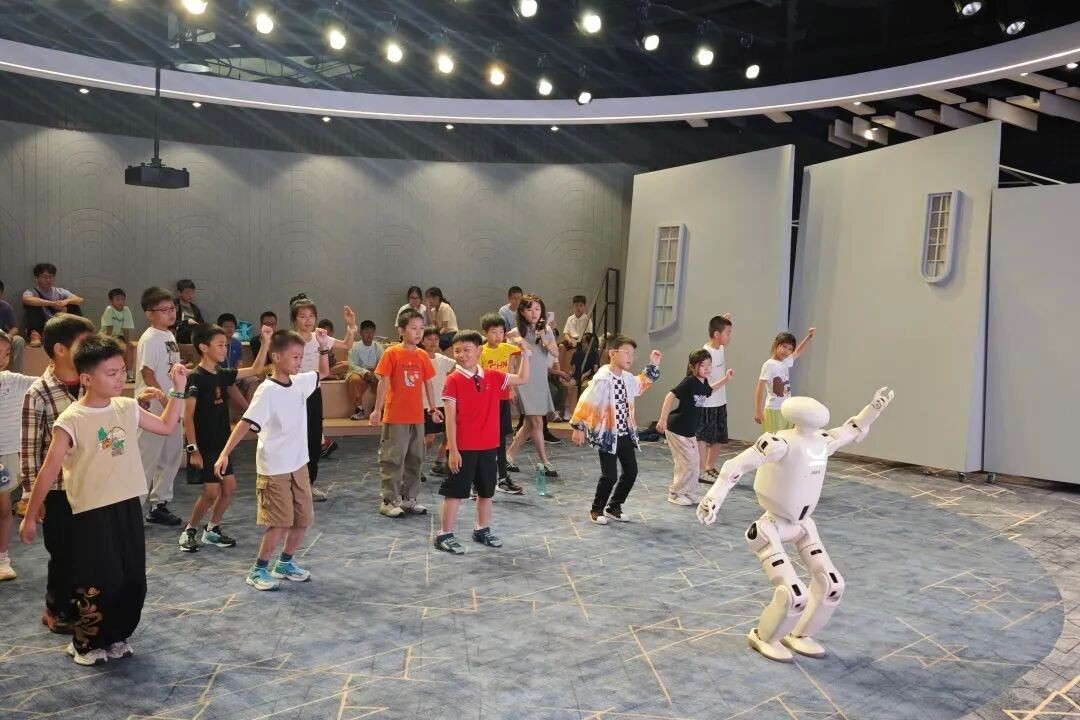
On July 22, the Future Science and Technology Innovation Camp at the SSTM held a special science communication event titled "JAKA π: From Tools to Robots with a Sense of Life." The Museum's Exhibition and Education Center invited a robotics engineer to share professional insights, attracting numerous young participants who experienced firsthand the appeal of cutting-edge technologies in AI and humanoid robotics through immersive activities.
The event consisted of two main sessions: an interactive experience with the JAKA π humanoid robot and a science communication presentation by a professional engineer. Children had the opportunity to interact with the π robot up close, experiencing the wonders of embodied intelligence firsthand through its flexible and fluid movements. The special presentation at the Singularity Theater provided a comprehensive explanation of the research and development principles behind robots and the intricacies of AI training, offering young participants an engaging practical lesson in scientific and technological innovation.
During the presentation, the instructor introduced robotics in an accessible and engaging manner. Beginning with familiar examples such as robots depicted in science fiction films and television programs, household robotic vacuum cleaners, and robotic arms used in industrial settings, he clearly distinguished between the broad and narrow definitions of robots and traced the complete evolution of robotics worldwide, from industrial welding equipment to collaborative robots and humanoid robots with embodied intelligence. Drawing on real-world footage and structural diagrams, he explained in detail the robots' "sensory organs and limbs," including visual cameras, force and tactile sensors, mobile bases, and multifunctional working tools. He also demonstrated the logic behind robotic movements, including linear, circular arc, and repetitive motions. Through graphical programming and analogies drawn from everyday life, he made complex concepts such as program control, conditional statements, and loops easy to understand.
Turning to the rapidly developing field of artificial intelligence, the instructor explored the Turing Test and the timeline of AI development, explaining two generations of intelligent technologies, namely model-driven and cognition-driven technologies. He placed particular emphasis on the complete training system behind the JAKA π humanoid robot, revealing the principles that enable humanoid robots to "understand their surroundings, interpret instructions, and act autonomously." A wide range of real-world examples, from operations on industrial production lines to everyday applications such as coffee making, calligraphy, and dancing, allowed the children to see the diverse potential applications of robots.
The presentation was filled with enthusiasm, with the participating children remaining attentive and engaged throughout the event and eagerly raising their hands during the interactive question-and-answer session. Their imaginations ran wild as they posed a variety of creative questions: Is a 3D printer a robot? Will robots be able to help me with my homework in the future? Will we be able to hire robots instead of nannies in the future? In response to each imaginative question, the instructor patiently provided detailed explanations based on practical research and development experience, translating professional technical concepts into language that children could understand. The lively exchanges of questions and answers continually sparked new ideas about scientific and technological innovation.
Through a combination of "Hands-on Interaction with Real Robots + Professional Lectures," this AI robotics science communication event established a learning pathway for scientific and technological innovation encompassing "Intuitive Experience, Understanding Principles, and Innovative Thinking," fully demonstrating the role of the innovation camp in introducing young people to science and fostering their innovative abilities. Looking ahead, the Future Science and Technology Innovation Camp at SSTM will continue to organize more practical activities focusing on cutting-edge technologies, provide high-quality platforms for science communication, and continuously nurture young people's curiosity about scientific and technological innovation. These efforts will help more young technology enthusiasts explore the frontiers of science and technology and plant the seeds of scientific and technological innovation.

 LINK :


