
SSTM opens “Questions Beyond Boundaries” temporary exhibition, exploring the future of human-machine symbiosis through science, technology and art

On September 20, the opening ceremony of the “Questions Beyond Boundaries” temporary exhibition and the second session of the “Tomorrow Live · Pioneers Salon” were held at the “City of Tomorrow” Theater of SSTM. Organized by SSTM, the exhibition brings together 18 original art installations created through successive collaboration among scientists, artists, AI researchers and robotics research teams. Approaching artificial intelligence from an artistic perspective, the exhibition invites the public to explore the deeper relationship between humans and intelligence from multiple dimensions and envision a future of human-machine symbiosis. The exhibition opened to the public on September 22 in the temporary exhibition hall on the second floor of SSTM and will run until March 25, 2027.
As a major presentation by SSTM in its efforts to integrate “Science × Art,” the “Questions Beyond Boundaries” exhibition centers on the theme “All Things Converge, with No Fixed Boundaries.” Here, “boundaries” represent the limitations of human cognition, while “questioning” serves as the fundamental driving force for breaking through these limitations and moving forward. Science and art are two fundamental pathways through which humanity understands the world. The former follows natural laws to deconstruct the world, while the latter expresses human emotions and reconstructs perceptions. Their integration challenges the public's longstanding perception of science as “rigid, tedious, and confined to formulas.”
The spatial design of the exhibition strongly reflects its central theme of “breaking boundaries.” Each independent exhibition area corresponds to a widely recognized scientific theory, while the connecting windows between the areas serve as pathways for overcoming cognitive limitations. As visitors move through the exhibition, they can directly experience the process of scientific boundaries being continuously challenged and extended through exploration. Unlike the one-way presentation of traditional art exhibitions, the installations encourage hands-on observation and real-time interaction, allowing visitors to understand the scientific principles underlying each installation through direct engagement. This creates a complete experiential journey from “viewing art installations” to “understanding the underlying science.”
All 18 works on display are original creations developed in China, with several representing artistic interpretations of China's cutting-edge research achievements in intelligent equipment, distinguishing the exhibition from others of its kind. For example, the “0/1” tunnel, constructed from 4,000 old-fashioned switches, uses 24 red switches to establish a mathematical mapping between binary digits and an image database containing tens of millions of images. Combinations of 266 green switches correspond to the total number of known atoms in the universe. By simply flipping the switches, visitors can trigger visual responses from the “binary universe,” gaining a tangible sense of the known boundaries and unexplored realms of human knowledge.

The interactive billiards installation “Rules” combines magnetic fields, blocks with uneven mass distribution, and an unstable tabletop to make ball trajectories, which would otherwise follow the laws of classical physics, completely unpredictable. Through this game in which “rules cease to apply,” visitors are encouraged to reconsider the idea that “scientific descriptions of the world are always approximations of reality, rather than reality itself.”
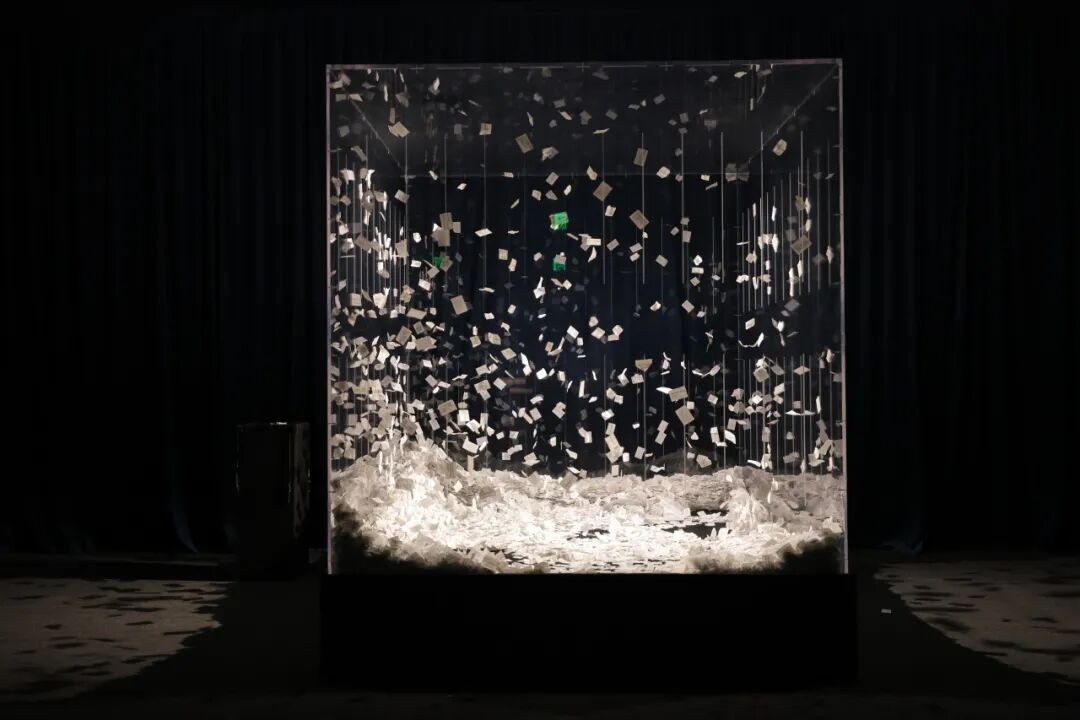
The installation “Questions About Questions” features a “whirlwind of questions” composed of 10,000 slips of paper inscribed with unresolved scientific questions spanning more than ten disciplines, including artificial intelligence, robotics, mathematics, physics, chemistry and life sciences. The dynamic vortex at the center of the whirlwind vividly illustrates the fundamental nature of human knowledge, which continuously evolves through questioning and expands at the boundaries of understanding.
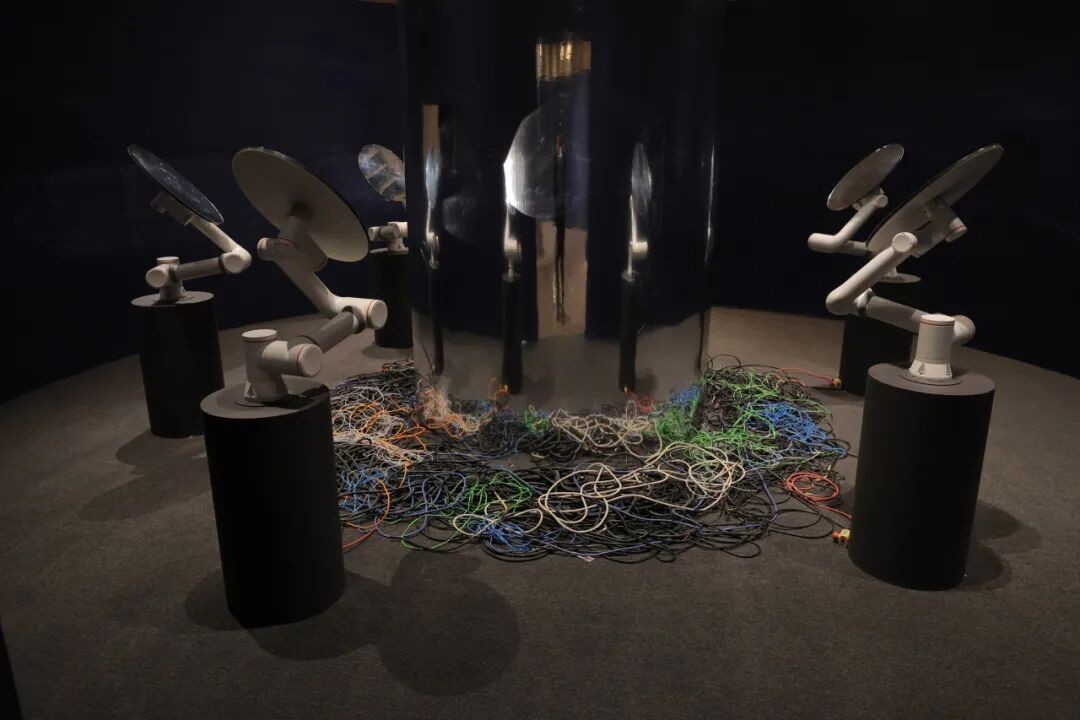
The installation “Mirror Realm” features six robotic arms arranged in a circle, each holding up a mirror to examine the others. Through a mirror experiment without a human-centered perspective, the installation transforms the abstract philosophical question of “where does self-awareness come from?” into a tangible visual experience, prompting profound reflection on the cognitive logic of machine learning.
The “Questions Beyond Boundaries” exhibition moves beyond simply showcasing technological achievements and challenges the stereotype that “science equals tedious formulas.” Each work is designed as an “interactive, dynamic science laboratory,” guiding visitors from a binary view of the universe to cross-sectional representations of fluid flow in fluid mechanics, and from the deconstruction of physical rules to the expansion of cognitive boundaries. Through the interaction between science and art, visitors are encouraged to appreciate the significance of dissolving boundaries and reflect on the symbiotic relationships between humans and intelligence, space and time, and nature. Beyond conveying specific scientific knowledge, the exhibition seeks to communicate the central idea that “boundaries are defined by humans, and questioning is the starting point of scientific exploration.” By encouraging more people to understand fundamental scientific principles while engaging in deeper philosophical reflection, it aims to foster a multidimensional perspective on exploration based on the “integration and symbiosis of science and art.”
As the opening event accompanying the exhibition, the second session of the “Tomorrow Live · Pioneers Salon” upheld its core philosophy of “bringing tomorrow's questions into today's public forum.” Under the theme “When Science and Art Question Each Other,” the event featured themed presentations and interdisciplinary discussions.
From a detail in an artwork to a discovery in scientific research, scientists and artists shared their own unresolved questions with one another and with every member of the audience. In doing so, they transformed SSTM into a public forum for exchanging ideas, open to the city and oriented toward the future, where discussions about the shared destiny of humanity and technology can continue to unfold.

 LINK :


