National Science Popularization Month brings new ways to explore science
September marked both National Science Popularization Month and the start of the autumn school term. The Shanghai Science and Technology Museum (SSTM) brought together its four major exhibition and education brands, "CONNECT SCIEANS," "INNOVATION CAMP," "SCIENCE PAL," and "SCIENCE LIVE SHOW," within a unified scientific inquiry framework built around four stages: "asking questions, exploring through practice, reflecting and improving, and communicating and sharing." On September 5, the back-to-school themed event "‘Science’ Is So Much Fun" officially kicked off, launching a month of activities centered on "learning by doing," with the four brands providing a common framework for science exploration.
A unified brand framework: Making "learning by doing" a shared approach
Each of the four brands has a distinct focus, yet all contribute to the same process of scientific inquiry. "CONNECT SCIEANS" encourages young people to develop an interest in asking questions and the skills to ask them effectively. "INNOVATION CAMP" provides educational resources and opportunities for personal development through hands-on activities. "SCIENCE PAL" caters to families and younger children, making science engagement "the best kind of companionship." "SCIENCE LIVE SHOW" brings scientific principles to the stage, combining education with entertainment. Together, these complementary brands form a coherent framework for "learning by doing," offering teachers, parents, and children different ways to discover and engage with science.
Bringing the brands to life: making scientific inquiry tangible
"Hands-on exploration" was at the heart of "‘Science’ Is So Much Fun." Rather than simply assembling a series of separate activities, the back-to-school program brought the four brands together in a carefully structured sequence reflecting the stages of scientific inquiry.
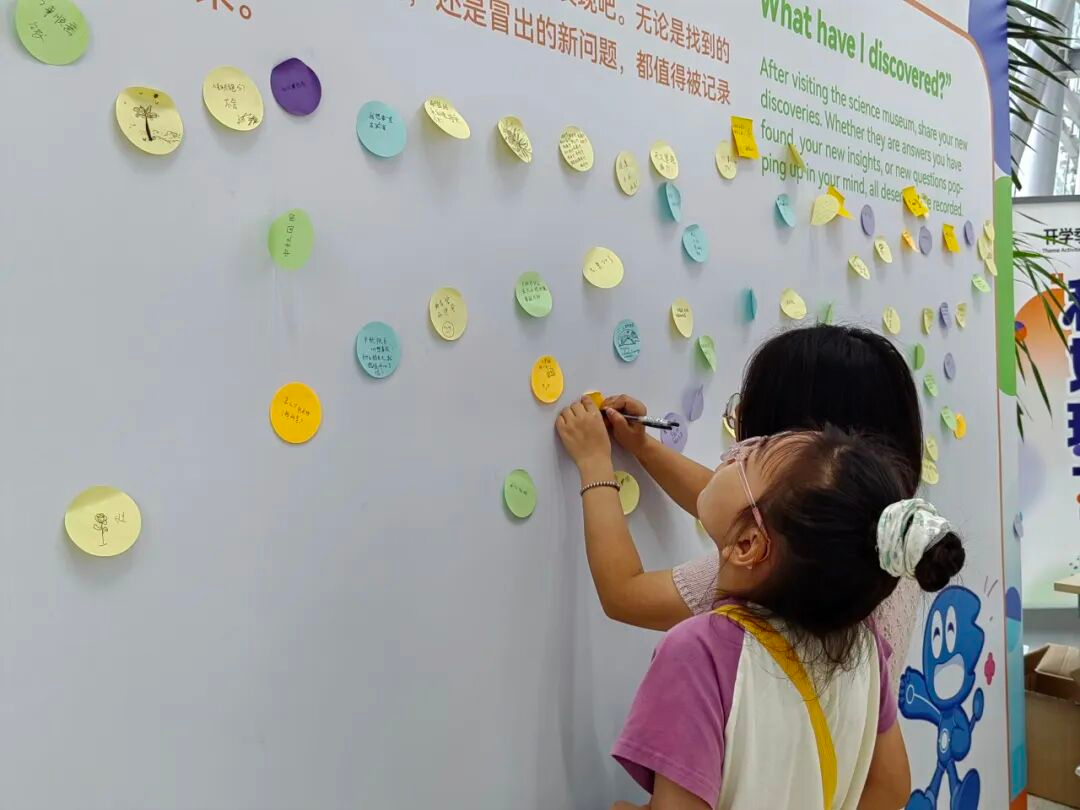
Asking questions: At the museum entrance, the "Just a Little Curious with the WALL" interactive photo wall featured a "Question Wall" and an "Inspiration Wall." Visitors were invited to write down their questions, marking the beginning of their journey of discovery.
Exploring through practice: "INNOVATION CAMP" hosted a community outreach fair on the BF level, featuring a handicraft area and a virtual reality experience area where visitors could put the idea of "hands-on science" into practice. Meanwhile, "Meet @ Scientists," a program under "CONNECT SCIEANS," paid tribute to John McCarthy, the "father of artificial intelligence." Thirty participants who shared McCarthy's birthday learned about his pioneering work in laying the foundations of AI. They also attended a lecture titled "Who Owns Intellectual Property in the Age of AI-Generated Content?" and took part in a workshop to build "Mechanical Walker" robots. These hands-on experiences offered insights into the questioning mindset and perseverance that drive scientific discovery, bringing the spirit of "learning by doing" to life.
Communicating and sharing: Before leaving the museum, visitors recorded their new discoveries on the "Inspiration Wall," completing the cycle of scientific inquiry from "asking questions" to "communicating and sharing." Their questions and discoveries were subsequently collected, organized, and shared with others, extending the warmth and inspiration of science education beyond each individual experience.
Throughout the same period, more than ten themed activities, including scientific experiments, interactive experiences, and science interpretation sessions, were introduced as part of the back-to-school program. These activities were incorporated into brands such as "SCIENCE PAL" and "SCIENCE LIVE SHOW," giving each brand its own opportunities to connect with visitors through practical experiences.
Brand collaboration: bringing together more resources for science education
Collaboration between the museum and enterprises brought "real-world technology" into science education. Working with corporate partners, SSTM introduced a hands-on model aviation program that combined explanations of flight principles with practical activities, guiding participants from understanding aircraft structures to assembling and test-flying model aircraft. Science lectures and handicraft workshops introduced children to shield tunneling and underground engineering. The museum also launched the "Robot Combat Experience Pop-up Event," a science popularization program featuring competitive humanoid robots. Through live robot combat, visitors could see how motion control, dynamic balance, and perception algorithms work in practice.
Collaboration between the museum and schools put students at the center of the experience. In the Tomorrow’s Walker exhibition hall, the "Young Peer Educators" team explained artificial intelligence to fellow students in language and ways they could easily relate to. Participants in the summer programs "Exhibit Designers" and "Young Science Interpreters" showcased their work through live presentations, demonstrating the entire creative process from observing exhibits and exploring their underlying scientific principles to developing ideas, producing designs, and presenting their finished work. Meanwhile, the "Red Scarf Guides: Keqi Youth Team" volunteer interpretation team developed six science popularization routes covering six key areas of future industries. Following their training, 33 junior secondary school students took on frontline roles as volunteer guides. Their transformation from recipients of science education into active communicators of scientific knowledge offered one of the most compelling examples of "learning by doing" in action.
Extending the brands: Bringing science education to more communities
SSTM has also expanded its approach from "welcoming visitors to the museum" to "bringing science education directly to communities." In September, museum educators traveled to Hainan to deliver mathematics and physics lessons to students across primary, junior secondary, and senior secondary schools. During these lessons, they incorporated the principles of acoustics, optics, and buoyancy into hands-on projects, allowing students to explore science through repeated experiments involving "sinking" and "floating." By making scientific concepts accessible through practical activities, the initiative helped bring high-quality science education resources to more classrooms, including those in communities farther from the museum.
Looking ahead, the SSTM will continue to develop signature educational programs as a regular feature of its offerings. Each activity will follow a process of “asking questions, exploring through practice, reflecting and improving, and communicating and sharing,” making “learning by doing” more than a one-off experience. Instead, it will become a recurring part of everyday education, allowing science education to flourish at SSTM throughout the changing seasons.

 LINK :


