
“Meet @ Scientists” explores the atomic world and nuclear technology in tribute to the “Father of Nuclear Physics”!
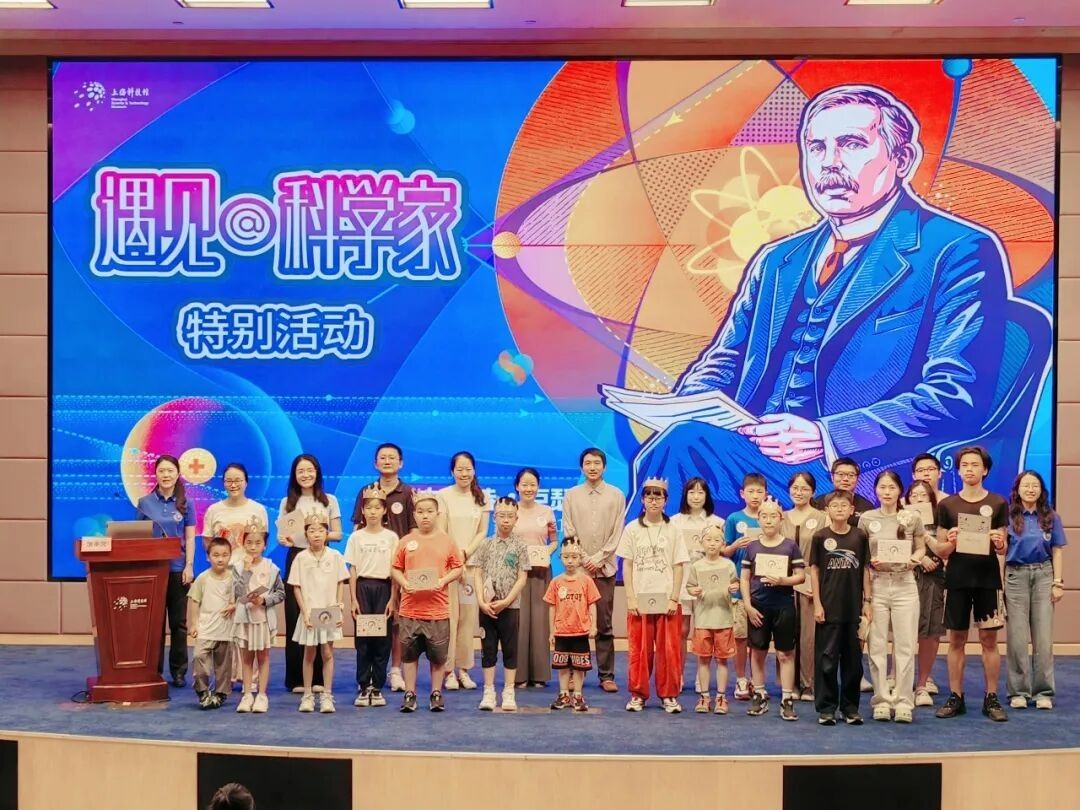
To commemorate a pioneer of science and promote the spirit of scientists, a special event titled “Meet @ Scientists: A Tribute to Ernest Rutherford” was successfully held at the auditorium of the SSTM on the afternoon of August 30. As a pioneer of nuclear physics, Rutherford discovered the atomic nucleus through his gold foil experiment, proposed the planetary model of the atom, and achieved the first artificial transmutation of an element. He also mentored more than ten Nobel Prize winners. His scientific approach, characterized by a willingness to question established ideas, a commitment to experimental verification, and an open and inclusive attitude, holds significant educational value.
The event featured a researcher from Fudan University, who presented messages of encouragement from a scientist, birthday wishes, personally signed birthday cards, and customized “Meet @ Scientists” birthday souvenirs to 30 participants who shared Rutherford's birthday. The researcher also joined them for a commemorative group photograph.
The researcher's science lecture, titled “Tiny Atoms, Shaping Humanity's Future,” began with stories from Rutherford's life and his alpha particle scattering experiment. It took the audience inside the atom to explore its structure and appreciate the scientific spirit of questioning established ideas and seeking answers through experiments. Using examples such as the nondestructive testing of the Sword of Goujian, King of Yue, atomic clocks and satellite navigation, nuclear energy development, and nuclear fusion research, the researcher explained the close connections between nuclear science, human life, and social development. The lecture illustrated the technological progress humanity has made from understanding atoms to harnessing their potential, helping young participants appreciate the power of nuclear technology to connect the past, position the present, and illuminate the future.
Drawing on the frontiers of fundamental research, the lecture systematically traced the development of scientific research from Rutherford's scattering experiment to China's “artificial sun” and explored the future direction of nuclear technology. It also encouraged the audience to develop a sound understanding of science and an awareness of innovation. The interactive session was lively, with audience members eagerly raising their hands to ask questions and deepening their understanding of the atomic world and nuclear technology through the exchange of questions and answers.
Following the lecture, the birthday celebrants took part in a “Science Experience Fair” specially organized by SSTM for the occasion. Centered on the theme of “Scientist Badge Making,” the activity combined fundamental physics knowledge with hands-on craftwork, guiding students to design and create their own badges featuring Rutherford's planetary model of the atom. By drawing patterns of the atomic nucleus and electron orbits and using simple materials such as colored cardstock, paintbrushes, and safety pins, students recreated the classic model of atomic structure on their badges, gaining an understanding of Rutherford's contributions to our knowledge of atomic composition through hands-on practice.
Each month, the “Meet @ Scientists” program selects an outstanding scientist in the history of science whose birthday falls in that month and organizes a “Scientist Themed Month” event. In 2026, the program underwent a comprehensive upgrade, introducing a variety of activities, including scientist birthday celebrations, scientist storytelling sessions, and Science Experience Fairs (science performances, science lectures, STEM courses, VR/MR experiences, mini exhibitions, and online promotion). Through multiple channels and a comprehensive range of activities, the program showcases scientists' research achievements, promotes the spirit of scientists, and elevates scientists to “star” status. It aims to foster a new social culture that values science and provide sustained momentum for improving scientific literacy among the general public.

 LINK :


