
Incredible Reading: Rescuing Titanic and Sharing Science and Love at the Science Museum!
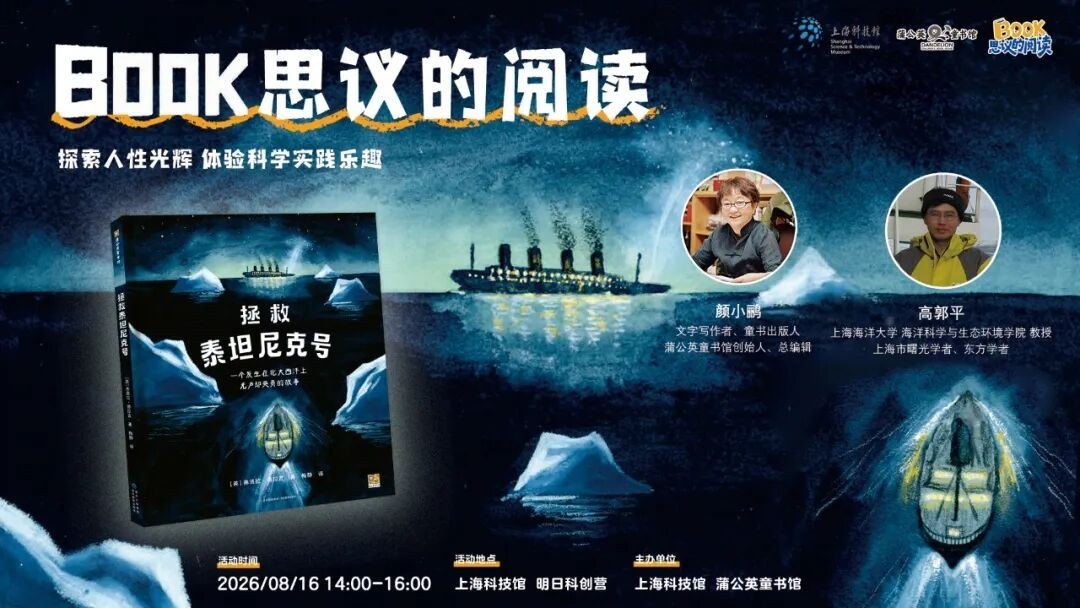
On August 16, the Future Science and Technology Innovation Camp of the Shanghai Science and Technology Museum (SSTM) successfully held an immersive reading event themed "Incredible Reading: Rescuing Titanic." Focusing on an innovative educational model integrating "reading, critical thinking, and practice," the event invited a renowned children's book expert and a marine science expert to deliver a jointly taught session. The event encouraged families with children aged 10 to 14 to move beyond traditional book reading and explore the human warmth and mysteries of marine science behind the Titanic rescue story. Through shared reading and educational exploration, a science lecture, and hands-on science and technology innovation activities, participants consolidated their knowledge and developed their abilities.
The century-old story of the Titanic disaster is widely known, yet few people are familiar with the Carpathia, which rushed to the rescue in the face of danger. This little-known rescue ship braved the wind and waves with courage and a sense of responsibility, bringing hope to countless lives and becoming a beacon of warmth in the story of the deep sea. Taking this unique perspective as its starting point, the event broke down the boundaries between science communication and reading, moved away from dull, text-based instruction, and closely integrated human stories, marine science, and hands-on practice. It created an engaging, multidimensional, and immersive educational experience for young participants, giving depth to reading, warmth to science, and tangible rewards to practical activities.
The event specially invited two experts in their respective fields to share their knowledge and insights, providing participating families with a high-quality learning experience led by two instructors. An experienced children's book publisher used the picture book Rescuing Titanic to guide children through an immersive reading of classic passages, carefully reconstructing the entire sequence of events, from the Titanic disaster to the Carpathia's urgent rescue mission from afar. Through vivid storytelling and interpretation, the children were encouraged to understand the courage, perseverance, and compassion for human life demonstrated in the face of disaster.
A marine scientific research expert delivered an informative and technically detailed marine science session for the young participants. Drawing on his extensive experience in scientific expeditions, the expert provided in-depth explanations of specialized topics, including the characteristics of the marine environment and maritime emergency rescue, in clear and accessible language. By connecting the Titanic disaster with real-world marine science scenarios, he made abstract concepts in physics and marine science tangible and easy to understand. This effectively bridged the gap between textbook knowledge and scientific applications in the real world, significantly broadening the children's understanding of the ocean and their scientific knowledge.
During the eagerly anticipated hands-on session, the young participants independently completed the entire experiment. Using only simple materials such as paper, tape, and paper clips, they applied the principles of buoyancy and balance learned in class, developed creative designs, made patient adjustments, and built their own small boats capable of carrying weight. Throughout the processes of construction, testing the boats on water, and making improvements, the children made full use of their innovative thinking and practical skills, gaining firsthand experience of how scientific principles are applied in practice. The activity vividly demonstrated the educational significance of "putting knowledge into practice." One carefully crafted paper boat after another floated steadily on the water, reflecting the children's creativity and patience while also paying tribute in a unique way to the spirit of rescue embodied by the Carpathia.
Through its innovative approach of integrating the humanities with science and combining theory with practice, the reading event enabled children to experience human warmth through stories, broaden their horizons through science communication, and strengthen their abilities through hands-on activities. The participants not only acquired knowledge and skills but also gained a deeper understanding of the profound significance of courage, responsibility, and kindness.

 LINK :


